News
The Blood of Dawnwalker PS5 Preload Details, Directional Combat, and Daytime Vulnerability Revealed
Prepare for the September 3 launch with new details on PS5 preloads, Kingdom Come-inspired directional combat, and why daylight is your greatest enemy.
With the highly anticipated September 3 release date rapidly approaching, the information flow for The Blood of Dawnwalker has evolved from a slow drip into a steady torrent. Rebel Wolves is finalizing the last few marketing beats, and recent reports have brought critical technical specifications and nuanced gameplay details to the forefront. From the logistical hurdles of PS5 preloads to the stark realities of surviving daylight in a hostile world, the community is finally piecing together exactly what this ambitious dark fantasy RPG expects from its players.
We have gathered the latest insights surrounding the game’s directional combat influences, the strict punishment of daytime encounters, and what the newly revealed 55 to 70-hour playtime actually entails.
PS5 Preload and Storage Preparations
For console players, launch day logistics are just as important as character builds. According to recent backend tracker reports originally highlighted by TwistedVoxel, the download size and preload details for the PlayStation 5 version of The Blood of Dawnwalker have started to materialize. While the exact gigabyte count is subject to minor fluctuations depending on the final day-one patch, players are heavily advised to clear substantial SSD space.
Considering the game utilizes Unreal Engine 5 to render the massive, seamless world of Vale Sangora—complete with dense gothic architecture and expansive underground burrow systems—the file size is expected to be massive. The preload phase will reportedly go live a few days prior to the official September 3 launch, giving players enough time to secure the necessary assets.
We already know the PC community faces stiff hardware demands, as detailed in our analysis of the PC system requirements. For console players, ensuring your storage is managed beforehand means you will not be stuck staring at a slow download bar while the rest of the community is already taking their first steps as the cursed protagonist, Coën.
Directional Combat: A Kingdom Come Influence
Perhaps the most substantial gameplay update to surface this week concerns the intricacies of the melee systems. We previously reported on the game director’s comments comparing the rhythmic, timing-based nature of parrying to a music game. However, a new feature via MSN gaming notes that the combat is also heavily inspired by the directional striking mechanics seen in Kingdom Come: Deliverance.
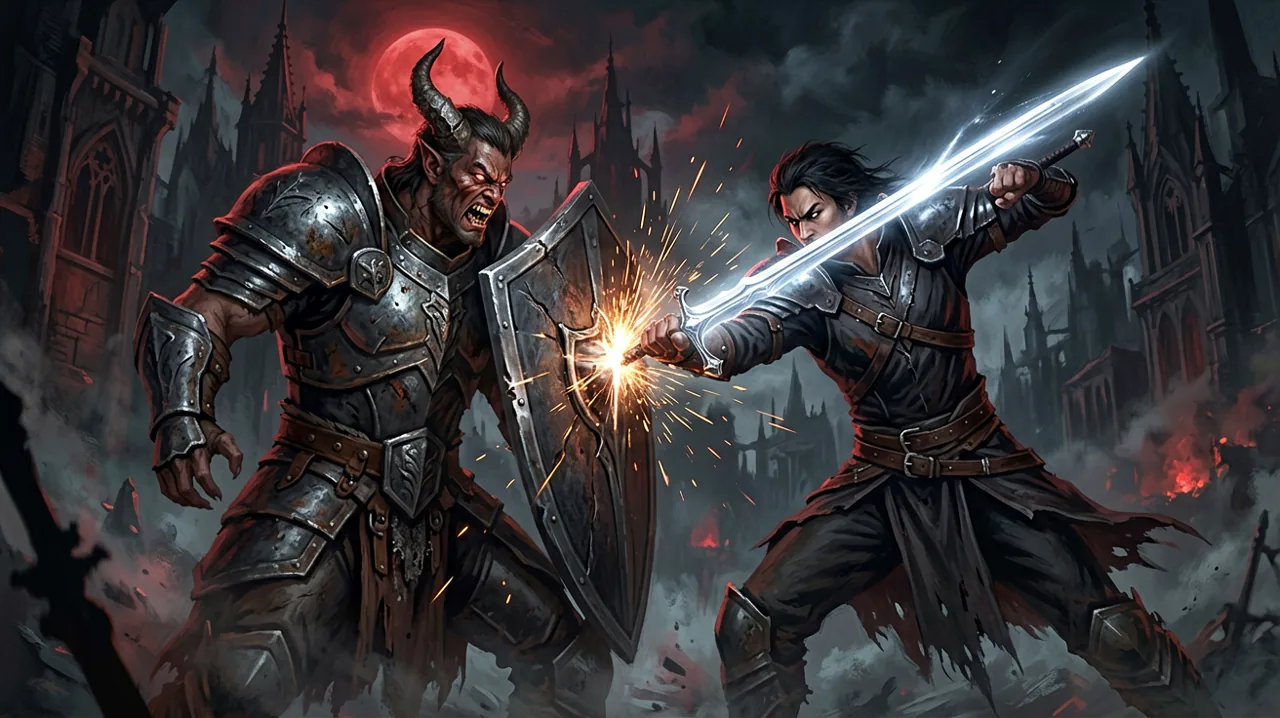
This drastically shifts our understanding of how engagements play out. Combat in The Blood of Dawnwalker is clearly far more complex than mashing light and heavy attack buttons. Players will reportedly need to carefully observe enemy stances and manually angle their strikes—choosing to attack from the left, right, top, or bottom—to bypass raised shields and thick armor plating. When crossing swords with highly disciplined human soldiers or formidable vampire officers, blindly swinging will likely result in your attacks clanging off armor, followed by a devastating counter-thrust.
Combining this directional offense with the rhythm-based defense paints a picture of a highly tactical, deliberate pacing. You have to parry perfectly to the beat of an enemy’s assault, throwing them off balance, and then instantly follow up by angling your joystick or mouse to exploit the specific gap in their guard.
This mechanical depth perfectly complements the broader toolset. If a heavily armored halberdier is effectively blocking your high attacks, casting a quick, disruptive spell at their feet using the hex magic system might force them to drop their shield, opening their upper torso to a lethal directional strike. It is a loop that punishes impatience and rewards spatial awareness.
The Perils of Daylight: Why Coën is Easy to Kill
Rebel Wolves has repeatedly emphasized the duality of the protagonist’s cursed existence, but recent statements provided to GamesRadar+ clarify just how extreme that contrast will be in practical gameplay. Developers explicitly noted that players will be “quite easy to kill” during the day. The studio purposefully avoided creating an “overpowered protagonist” who can casually slaughter city guards at high noon.
When the sun is up, Coën’s vampiric attributes are severely dampened. You will not have the luxury of shrugging off musket fire, and your regenerative capabilities are reportedly incredibly sluggish. Daytime encounters require a methodical, almost survival-horror approach. If a fight breaks out in the middle of a busy street during the afternoon, you are at a distinct mechanical disadvantage. Enemies hit harder relative to your diminished health pool, and standard human weapons pose a lethal threat.
This daylight vulnerability is a brilliant piece of ludonarrative design. It forces players to genuinely respect the world’s threat level and encourages a shift in playstyle. During the day, you must lean on stealth, bribery, and silver-tongued dialogue options to navigate the city. You might spend your daylight hours scouting a fortified bandit camp, mapping out patrol routes, and identifying structural weaknesses, only to retreat and wait for dusk to launch the actual assault.
The message from the developers is clear: attempting to play this like a traditional, god-tier power fantasy RPG under the midday sun will result in swift, punishing defeats. For a deeper look at how the nocturnal transformation alters the power dynamic, you can review our breakdown of the vampire powers and the wolf form.
A 55 to 70-Hour Narrative Sandbox
Alongside combat tweaks, recent previews have pinned the expected playtime at around 55 to 70 hours for a comprehensive playthrough. While we have previously touched on the community’s reaction to the game’s overall length in our how long to beat feature, the new context provided by MSN gaming confirms that this runtime is almost entirely dictated by the player’s agency.
The game aggressively rejects the traditional RPG quest funnel. You are not forced through a rigid sequence of Main Quest to Side Quest to Final Boss. Instead, The Blood of Dawnwalker presents a true narrative sandbox where the in-game calendar constantly ticks forward. You must make your own priorities and decide which political or supernatural problems deserve your limited time.
Because the game refuses to hold your hand, those 55 to 70 hours are not padded with generic fetch quests. They are filled with organic exploration, managing faction reputations, and navigating complex dialogue trees. If you feel confident in your combat skills, you can technically attempt to confront major antagonists almost immediately, a radical design choice we discussed when the developers confirmed you can rush the final boss. The length of your journey depends entirely on how thoroughly you wish to prepare for the inevitable conclusion.
The Uriashi: Misunderstood Giants of Vale Sangora
Beyond the human factions and aristocratic vampires, the world is populated by diverse fantasy races with complex societal standings. A recent lore drop from community creator Kazuliski highlighted the Uriashi, a race that has sparked significant interest. According to the newly revealed bestiary descriptions, the Uriashi are widely feared by the general populace. They are intimidatingly tall, incredibly bulky, and possess prominent horns that lend them a devilish, demonic appearance.
However, the official lore specifies that the Uriashi are not inherently aggressive monsters waiting to be slain for experience points. In fact, they treat humanity with the exact same cautiousness and deep distrust that humans direct at them.
This nuance is vital for roleplaying. It strongly suggests that encounters with the Uriashi do not have to end in bloodshed. They are a marginalized, misunderstood race merely trying to survive in a hostile and prejudiced world. Astute players will likely have opportunities to negotiate, trade, or even ally with Uriashi enclaves, provided they can overcome the initial cultural hostilities. Earning the trust of an Uriash settlement could provide you with powerful, heavy-hitting allies during large-scale conflicts against the ruling elite.
Whispers of the Rebellion: The Scarred Ally
The community has been meticulously dissecting every frame of the recent story trailers, and one particular unknown character has captured widespread attention on Reddit. Appearing briefly in a somber, weapon-filled room, a heavily scarred man—bearing horrific marks that resemble either deep lashings or systematic blade cuts—is seen telling Coën, “I have no love for Brencis’ regime, he is a vile monster.”
Given that the scene is bathed in darkness and Coën’s eyes exhibit the tell-tale vrakhiri glow of the night, fans strongly suspect this scarred individual is a key, yet-to-be-named figure within the underground rebellion against Brencis and the vampire officers. His rugged, battle-worn appearance and explicit hatred for the current regime suggest he might serve as a primary quest giver for resistance operations, or potentially as a combat companion.
While Rebel Wolves has deliberately kept the identities of the rebellion’s high command under wraps to prevent spoilers, this scarred man clearly plays a pivotal role in organizing the disparate, downtrodden factions of Vale Sangora against their immortal overlords. Players will need all the help they can get, and finding allies who share a mutual hatred for Brencis will be crucial to surviving the overarching narrative.
As the launch window closes in, the interlocking systems of The Blood of Dawnwalker are finally coming into focus. With a directional combat system that punishes thoughtless button mashing, a harsh daytime penalty that demands tactical restraint, and a vast sandbox narrative that lets you dictate your own fate, Rebel Wolves is crafting an experience that demands your full attention.